Brought to you by the Massachusetts Historical Society

"I have nothing to do here, but to take the Air, enquire for News, talk Politicks and write Letters."

John Adams to Abigail Adams, 30 June 1774

Monday, June 6, 2011

Saltonstall as "Adams Lite": Tastes Great, Less Filling

Mr. [John Quincy] Adams is now the rising sun, and of course finds many idolaters. You can hardly conceive the strange appearance he makes--so cold--so unbending rigid muscles amidst such smiles, such good humor, gaiety--and among his own guests too. It seems a miracle that he has ever been chosen President of the U. States. Is it an invincible proof of his eminent merit, or the result of a singular concurrence of fortunate circumstances? Mrs. A. is the very antipode--if you will allow the term to be applied to a lady....And I fear that she has a Courtier's hart [sic]--or like him is heartless.

(Letter from Leverett Saltonstall to his wife Mary, 24 Feb. 1825)

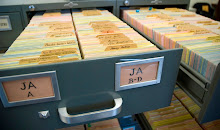
This little teaser is just my way of introducing the Saltonstall family papers slip file project, another grant-funded paper-to-digital conversion modeled on the Adams family catalog. We here at the Massachusetts Historical Society have come to call the Saltonstall slip file "Adams Lite" because it is both much smaller (only 3,000 slips) and much more straightforward than its unwieldy counterpart. Both catalogs consist of a series of paper slips describing individual documents: author, recipient, date, place, length, etc. But unlike Adams, this slip file describes papers in a single collection at the MHS: the Saltonstall family papers, Ms. N-2232. The entire data set fits in a single xml file, and all of the information has been entered, controlled, and verified by one person. And lastly, because publication of the Saltonstall papers was completed years ago, this database requires only one static interface--basically a searchable item-level collection guide. The Adams Papers Editorial Project, on the other hand, is ongoing, so that database requires two interfaces: one static, for public use; the other dynamic, to be edited by Adams Papers staff.

The Saltonstall database fulfills a requirement of the original Adams slip file grant, awarded in the fall of 2008, which specified that that project would serve as a prototype for similar projects. The Saltonstall conversion has been in the works since the beginning of 2010, and many MHS staff members have contributed to the project. Laura Lowell processed the Saltonstall family collection, and our digital team of Nancy Heywood, Laura Wulf, and Peter Steinberg have digitized, transcribed, and marked up many individual items for presentation on the web. I was responsible for building the database, using the Adams slip file as a model.

Mary Claffey's work on the Adams slip file laid most of the groundwork for me. Rather than reinvent the wheel, I literally copied and pasted her schema and revised her tags to suit the needs of the Saltonstall family papers, scaling it down by deleting unnecessary elements and adding or repurposing others. Our web developer, Bill Beck, is designing an attractive and user-friendly interface, also modeled on the Adams slip file, and Laura Lowell's collection guide to the Saltonstall family papers will link to the database. It was a lot of fun to work with so many other members of the department; everyone brought their own strengths to the project.

The Saltonstall family, like the Adams family, is chock full of prominent and interesting people, spanning several generations. Leverett, Sr. (quoted above) was a member of the Massachusetts House of Representatives, the Massachusetts Senate, and the U.S. House of Representatives, and he served as the first mayor of Salem, Mass. His wife, Mary Elizabeth (Sanders) Saltonstall, was the daughter of Thomas Sanders, a well-known Salem merchant. Leverett's great-grandson, also named Leverett, was the governor of Massachusetts during World War II and a U.S. senator for over 20 years.

Keep an eye on the MHS website for further information about both projects.

Wednesday, May 18, 2011

The Goldenrod Affair

In the Adams Paper slip file, the chronological run is considered the master and it is that which was microfilmed and used to create the digital control file. In adding document types, which was based on an equally impressive alphabetical run (which includes, for the prominent Adamses, a select list of subjects) it was determined that some slips were present in the alpha run and not in the chronological run. These were goldenrod slips, which are used in house as cross-reference slips to connect people, places, subjects, correspondence, etc. Probably a lot more. The current task to which I have been assigned is going through the slips in the Alphabetical run and identifying those slips of goldenrod color that were not also present in the chronological run. The process includes making copies of those slips not found and then adding them to the Digital Control File.

Before this, when creating a new slip one would find a slip of similar color, copy it, and then edit to suite. Now, though, we have a new option in the interface that enables us to create a new slip from scratch. A most helpful part of the tool.

Another project that is ongoing at the time - thought not being completed by the contributing members of this blog - is that updates and changes to existing slips is taking place. There is a big three-ringed binder of these changes. A process that took heaps of time in its analog format is now being completed quite a bit more swiftly. This is not always easy and has involved some collaboration between the Adams staff and the control file gurus, some instruction, and the detection & correction of bugs.

Thursday, May 5, 2011

Fun with searching

When editing individual records in the Adams slip file, it helps to use a unique keyword or phrase to limit your search results and pinpoint the exact slip you're looking for. Case in point: I was adding document types to records and came across a slip containing the phrase "bill for manure." I typed that phrase into my search box, confident I would retrieve only the specific record I was looking for. Imagine my surprise when I retrieved four! All four bills date from the year 1880 and belong to Charles Francis Adams (1807-1886). Expanding my search to just the word "manure," I found another bill, which I hadn't initially retrieved because of the variant phrasing on the slip. A sixth result was a letter from Charles' grandfather John Adams to Cotton Tufts, dated 80 years earlier, about a funeral oration for George Washington. John then goes on: "The transition to be sure from such a subject to my uncultivated business is very abrupt. But I must say a few words....I hope Porter has carted or shedded all the manure on the Hill....I wish you would contract with Carter to bring me up an hundred Loads."

Image of Charles Francis Adams from the Portraits of American Abolitionists photograph collection at the MHS.

Monday, May 2, 2011

Accessing Accessions

Now that encoding is complete and clean-up/quality control well underway, members of the Adams Papers slip file staff have been working on enriching the information in the database in a variety of ways. One way is by providing links to the many other Adams resources already available online. I recently added links in the Accessions Database to collection guides online at the MHS website.

The papers described in the slip file represent all known Adams documents held by institutions around the world. Included are Adams-related items in many different collections at the MHS that have come to us over the years. In the Accessions Database, these documents are listed by accession number, along with the name of the collection in which they can be found. So, for example, if a collection of John Doe papers was given to the MHS, and those papers contained some letters from, say, Abigail Adams to Mrs. Doe, each Adams letter would be assigned a unique number in the Accessions Database, and the name "John Doe papers" would appear alongside those numbers.

Since they were acquired, guides to many of our collections have been encoded and posted on our website. (We currently have over 330 guides to manuscript collections online.) My task consisted of searching the Accessions Database for MHS collections with online guides and adding links to those entries. This information can now be pulled into the Adams Papers catalog. When an individual record is retrieved, a sidebar with the heading "More about this slip" includes the name of the institution holding that item and, if that institution is the MHS, a handy-dandy link to the relevant online guide. Adams Papers editors can then use the guide to pinpoint an item's specific location, down to box and folder.

For those papers in collections without online guides, I added the manuscript call number to the notes field, just to make it a little easier to track down an item in our stacks.

Now, this job turned out to be fairly challenging because: 1) many collection names have changed over the years, 2) Adams editors often abbreviated the names they were familiar with, and 3) collections can have very similar names. (Just by way of illustration, the MHS holds separate collections called: the Henry Cabot Lodge collection, the Henry Cabot Lodge papers, the Henry Cabot Lodge, Jr. papers, and the Henry Cabot Lodge, Jr. papers II!) Not having the time to search through so many boxes by hand, I did the best I could to identify which items belonged to which collections. If a specific author or recipient wasn't listed in a catalog record or collection guide, I used other clues for confirmation, like bulk dates, subject headings, or acquisition, as well as the information on the slip itself.

And so we press on....

Wednesday, April 27, 2011

Conjectural Dates

Assigning the document types concluded about a week ago. The last document type tackled was JQA's poems, which were many. Some late decisions were made as we did this; the original slips for some document types - like JQA's poems - were filed in two ways: both chronologically and alphabetically. In the digital control file, there is no need for this kind of dual-classification. The headings were brought over verbatim and we realized that we could get rid of one altogether and rename the other so that the document type, for JQA's poetry, reads just simply "JQA-Poems, Hymns, Prayers, &c." You can see the "before" of this in the image below in the "Document Types & Names" post from 11 March 2011.

We'll continue to fine tune some of the Document Types as we go along but it feels great to have that part of the paper slips behind us. The web developer added to the search feature a way to narrow your search to each Document Type, so this is an added way of getting at the information which you will enjoy once it is rolled out.

For now, we're working through the conjectural dates of which there are 6,338 records. What this entails is reviewing each entry to make sure that the most up-to-date and accurate information is listed in the date field. Dates were reviewed in Level 1 encoding along with many other things. Unfortunately, some of the dates that needed updating based on the proofing were skipped and now it falls on my shoulders to review the records, fixing them up right. There are other reasons why the dates came over from the XML but won't get into for fear of seeming too defensive. It's a combination, I think, of human and technological reasons though. I've gone through 1,900 as of this post so while it doesn't seem like I'm making progress I am. It feels very "corporate" as I'm moving papers from one pile into another.

The conjectural dates exist for a number of reasons including undated papers, mis-dated papers, etc. For these items the ace staff of the Adams Papers do their level best to assign as accurate a date as possible based on research, expertise, etc. Over the generations of editorial staff, some slips have gone through several updates and now, now is the time for correcting it all so that when you get access to it you can be confident you're looking at great, solid, right information.

There are not 6,338 errors, mind you, and fortunately I do go through pages at a time where everything is synced up.